
In Focus: "Our Images Have to Be as Authentic as Possible"
4 minutes
A colorful chapter opener in Latin that motivates fifth-graders, or an electron microscope image of a plant cell for upper secondary students: educational media place diverse demands on image material, as well as on animations and videos. Searching for and finding media effectively therefore requires specialized tools. In this interview, Zeynep Arghan, who manages the picturemaxx application at Cornelsen end to end, explains what these tools are and how she uses them in her day-to-day work.
Interview with Zeynep Arghan, Consultant Legal Tech Solutions at Cornelsen Verlag GmbH
Ms. Arghan, what role do images play at a major educational media provider like Cornelsen? What kind of images are you focused on?
Zeynep Arghan: "As an educational media provider, we naturally want to bring the content in our textbooks closer to learners through attractive images. There's also a reason people say a picture is worth a thousand words. By now, though, it's no longer just about images. Animations, videos, and audio are becoming more important, because digital learning has already become part of everyday life. What matters most to us is finding images that are as authentic as possible."
How is the topic of images organized at your company, and how do you always find exactly the right "authentic" – or simply the best – image for every text?
Zeynep Arghan: "The image has to underscore and support the content. There's no such thing as a universally best image; it depends, for example, on whether it's a motivating chapter opener for fifth grade or an electron microscope image for upper secondary students."
The requirements for the "best" image go far beyond aesthetics:
"In an English textbook, what may matter is an authentic British setting; in a physics book, the pulley needs to be recognizable in enough detail that a task can be built around it; and in a biology textbook, we need to be certain that the toad shown is actually Alytes obstetricans and not, say, Alytes maurus. Biologists always want to see the whole animal – the image can't be cropped. Microscope images aren't much use without an indication of the magnification."
What challenges does a major educational media provider like Cornelsen face when it comes to researching media? And how are these challenges resolved?
Zeynep Arghan: "We have a broad spectrum of textbooks and digital education solutions – from early reading in elementary school to advanced biology courses in upper secondary education. So the challenges are correspondingly varied. A medium's metadata is crucial if our editors are to search for and find media accurately. Unfortunately, not all agencies handle this very well. Unsuitable or even incorrect tagging of media makes our search difficult. Another issue is that some providers don't give us all the information we need: Have the people shown agreed to publication? Are we even allowed to show this building or exhibition? Clarifying these questions ourselves costs resources and time."
You've been using my-picturemaxx for researching and purchasing media for many years now. How does the software help you in your day-to-day work? To what extent does it contribute to efficiency and quality in image research?
Zeynep Arghan: "I've worked as a picturemaxx administrator for many years. I support my colleagues in their daily work with my-picturemaxx, answer questions, and conduct regular training sessions. Through this training, my colleagues are kept well informed and can make full use of everything the application has to offer."
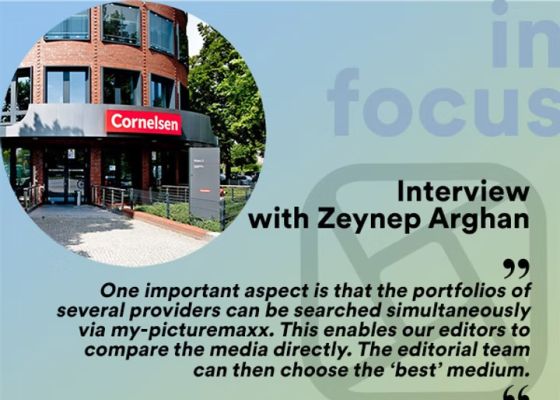
One important aspect is that my-picturemaxx allows you to search the portfolios of several providers at the same time. This lets our editors directly compare media side by side. The editorial team can then pick the 'best' one.
Which features in my-picturemaxx would you no longer want to do without, and why?
Zeynep Arghan: "At a major educational media provider like Cornelsen, many colleagues work with the software in parallel, so smooth collaboration and effective communication really matter. For this, we use, for example, the feature that lets us share lightboxes (that is, overviews of images you want to keep track of). This allows the editorial teams to work very efficiently together with the licensing department. We're also glad to make use of the option to create project folders: for the editorial teams' day-to-day work, these management tools are indispensable."
The interview was conducted by media journalist Julia Gundelach for picturemaxx.
Thank you!
Weitere Informationen
Zu Cornelsen: www.cornelsen.de
Zum Unternehmen: www.picturemaxx.com Kontaktaufnahme: info@picturemaxx.com